The Long Way Round: How Motorcycling Quietly Repairs the Modern Mind
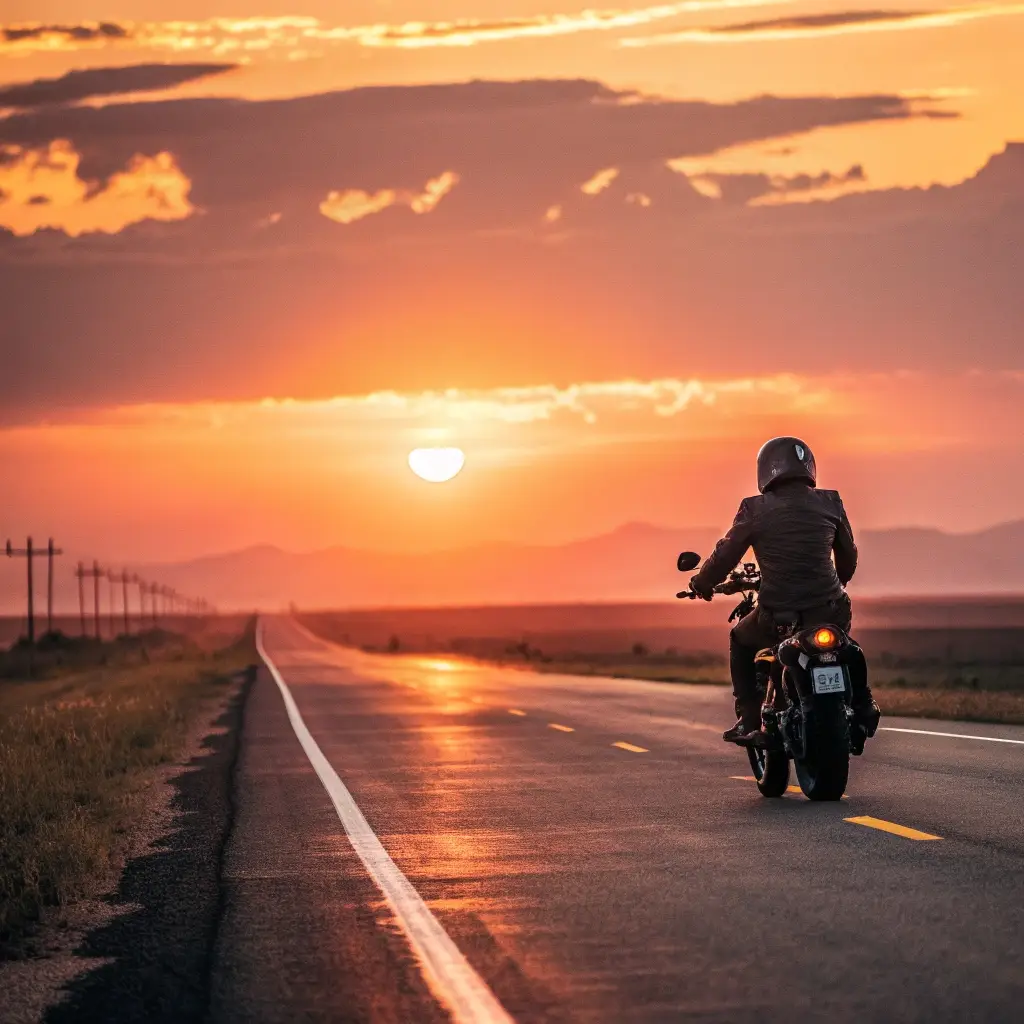
Ask any rider what happens in the first few seconds after they pull away from a red light and open the throttle, and you’ll hear some version of the same thing: the noise stops. Not the engine noise — that gets louder. The other noise. The email thread. The argument from breakfast. The low hum of everything else.
For a growing number of riders, that quiet isn’t just a nice side effect of a hobby. It looks a lot like therapy.
What the science actually found
For years, riders’ claims about motorcycling clearing their heads were treated as folklore — the two-wheeled equivalent of runner’s high. Real enough to the people feeling it, but hard to measure.
That changed in 2019, when neuroscientists at UCLA’s Semel Institute for Neuroscience and Human Behavior, led by Dr. Don Vaughn, ran the first study of its kind. Fifty experienced motorcyclists rode their own bikes on a 22-minute route wearing mobile EEG monitors, with their brain activity and hormone levels compared against sitting at rest and driving a car.
The results were striking: a 28% drop in stress hormone markers, alongside an 11% rise in heart rate and a 27% rise in adrenaline — a physiological signature similar to a light workout. At the same time, sensory focus sharpened in a way researchers compared to the difference between experienced meditators and non-meditators, and brain activity suggested a jump in alertness roughly equivalent to a cup of coffee.
Calmer and sharper, at the same time. Not many activities can claim that combination.
UK survey data backs this up from the rider’s own perspective, not just a lab. A Carole Nash poll timed to Mental Health Awareness Week found that 88% of riders said motorcycling benefits their mental health — 37% said it makes them feel calmer, 31% use it to escape everyday worries, and 20% described an active reduction in stress. None of this proves riding is uniquely powerful compared with, say, running or swimming — the UCLA team was careful to note other activities can produce similar effects. But it does suggest something real is happening, not just a story riders tell themselves to justify the leather jacket.
The riders who come back at 50
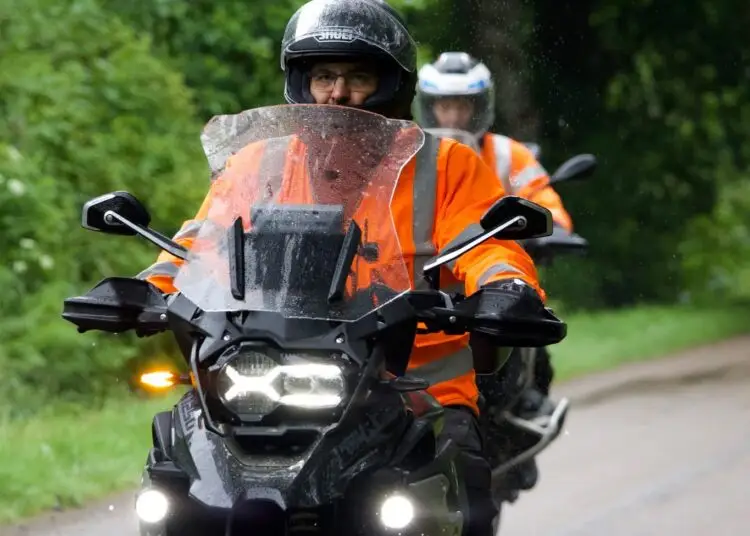
One of the more interesting patterns in the data is who’s actually doing the riding. In the UK, insurer Saga has tracked a sharp rise in older adults taking their motorcycle test — over-55s up more than 80% over five years, with test passes among 60-year-olds more than doubling.
The trend even has a nickname: “Baby-Vroomers” — riders who had a bike (or wanted one) in their twenties, spent decades on mortgages and school runs, and are now coming back to it, or discovering it for the first time, once the kids are grown and there’s a bit more money and headspace to spend on themselves.
Tellingly, only around one in five of these riders use their bike to commute. This isn’t about getting to work faster. It’s recreational, deliberate, chosen — and that matters, psychologically. A hobby taken up freely in midlife, after decades of obligations to other people, carries more weight as an act of self-definition than one picked up at nineteen because it was cheap and cool.
A motorcycle offers something rare: an activity that demands total presence, delivers a genuine sense of mastery, and doesn’t care how old you are — as long as you can still handle the bike.
Doctors and safety bodies rightly note that returning riders need proper retraining and honest judgment about reflexes and risk. But the psychological pull toward it in this age group is well documented, and not hard to understand.
If that sounds like you, the honest answer is you’re probably not too old to make the leap.
Why so many men ride alone, and like it
Solo riding is one of the more distinctive things about motorcycling as a mental-health outlet, and it seems to resonate particularly strongly with men. Part of this is practical: unlike most physical activities that double as social ones, riding actively rewards being alone. No one to talk to under a helmet. No group pace to match. No small talk at a rest stop unless you want it.
That’s not a bug for a lot of riders. It’s the entire point.
Psychologists who study men’s mental health often point out that men are, on average, less likely to process stress through direct conversation and more likely to work through it alongside an activity — fixing something, driving somewhere, doing rather than discussing. Riding fits that pattern almost perfectly. It offers what therapists sometimes call “shoulder-to-shoulder” processing rather than “face-to-face” processing: even when men ride in groups, they’re side by side or in a line, not making eye contact — which can make emotional processing feel safer and less exposed than sitting across from someone and talking about feelings directly.
There’s also the sheer cognitive load. A motorcycle demands total attention — read the road, judge the gap, feel the bike lean, watch the mirror — which leaves no bandwidth for rumination. For riders who spend their working lives managing other people, or who simply don’t have another socially acceptable outlet for wanting to disappear for an hour, that enforced, undistracted solitude functions like a pressure valve.
Control, silence and competence, rolled into one activity — delivered without anyone needing to ask if you’re okay.
A quiet note on risk
None of this is a case for recklessness. Motorcycling carries real physical risk, and the same qualities that make it good for the mind — solitude, speed, total absorption — are exactly why proper training, the right gear, and honest self-assessment (especially for riders returning after a long break) matter as much as ever.
Our 30-day plan for your first ride back covers exactly that — one manageable step at a time.
The mental health case for riding is a case for riding well — not for riding without care.
Still, between the physiology, the survey data, and the sheer number of people taking their test for the first time well into their fifties and sixties, the picture that emerges isn’t really about motorcycles at all. It’s about how few places modern life leaves for genuine, undistracted quiet — and how many people, especially men who were never given much permission to seek that quiet any other way, have found it two wheels at a time.
Sources
1Riding A Motorcycle Improved Metrics Of Focus And Decreased Stress Biomarkers, According To A New Neurobiological Study — PR Newswire / UCLA Semel Institute
288 Percent Say: Motorcycling Improves Mental Health — Carole Nash survey
3The rise of the Baby-Vroomers — Motorcycle Monthly / Saga Insurance data
4Motorcycling: Love of the Machine — Psychology Today
My own reason for coming back is in 20 Years Off the Bike: Why I Got Back Into Motorcycling, with a short video of the story too.
If you’d like to read more about the mental side of riding, including when it helps and when it doesn’t, see Motorcycling and Mental Health: Why Riding Clears Your Head.